Weed vs. Alcohol: Which Is Worse for Your Body, Brain, and Life?
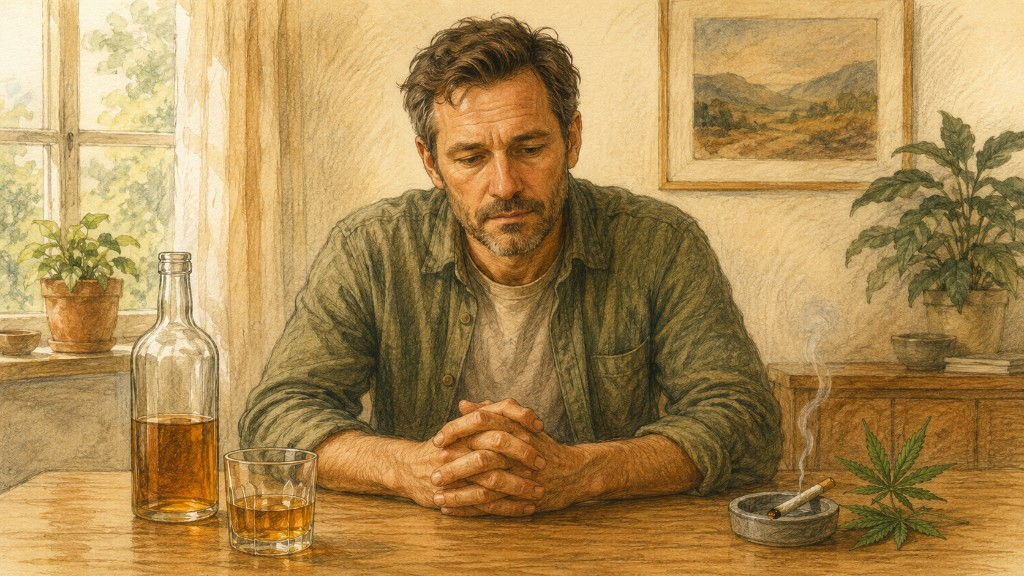
Most weed vs. alcohol comparisons begin with a simple question:
Which one is worse?
Whether you call it weed, marijuana or cannabis, the comparison often turns into a search for the safer escape.
Usually, the person asking does not want a medical lecture. They want to know whether replacing a few drinks with weed is a smarter choice, whether their nightly joint is really as damaging as somebody else’s bottle, or whether they can keep one substance while trying to escape the other.
The short answer is that alcohol causes far more clearly documented death and disease at the population level. It can poison you in a single night, damage nearly every organ over time and cause a dangerous withdrawal syndrome when a heavily dependent person suddenly stops.
Cannabis is much less likely to cause a fatal overdose by itself. But that does not make it harmless. It can affect memory, attention, judgment and coordination. Smoking it can damage the lungs. Frequent use can become cannabis use disorder, and high THC products may bring stronger risks than the weed people remember from decades ago.
So if the only question is which substance creates the greater burden of death and physical disease, the evidence points to alcohol.
If the question is which one can keep your life stuck, the answer becomes more personal.
The Short Answer: Is Weed Worse Than Alcohol?
For most adults, alcohol has the more severe and better established physical risk profile.
The World Health Organization estimated that alcohol caused 2.6 million deaths worldwide in 2019. It connected alcohol with noncommunicable diseases, injuries and communicable diseases, and estimated that 400 million people aged 15 and older were living with alcohol use disorders.
In the United States, the CDC estimated that excessive drinking caused about 178,000 deaths per year in 2020 and 2021. Roughly two thirds came from chronic conditions, while the rest involved acute causes such as alcohol poisoning, crashes, overdoses and suicide.
Cannabis does not currently carry a comparable, clearly measured death toll. The CDC says that a fatal overdose caused only by cannabis is unlikely.
That difference matters. It should not be minimized.
But “less deadly than alcohol” is not the same as safe, healthy or harmless.
Weed can still cause panic, paranoia, hallucinations, severe vomiting and accidental injury. It can impair driving and make existing mental health problems harder to manage. For some people, it becomes another daily promise to quit tomorrow.
The honest verdict is not that one drug is good and the other is bad.
It is that alcohol is generally more dangerous to the body and more likely to kill, while cannabis still carries meaningful risks to the brain, lungs, mental health, safety and daily life.
Alcohol vs. Weed: Overdose and Withdrawal
Alcohol can kill in one sitting.
When blood alcohol levels become high enough, the brain regions controlling breathing, heart rate, temperature and the gag reflex can begin to shut down. A person who appears to be “sleeping it off” may actually be experiencing alcohol poisoning.
Long term heavy drinking creates another danger: withdrawal.
Someone who has become physically dependent on alcohol can experience shaking, sweating, vomiting, confusion, hallucinations or seizures after stopping. Severe alcohol withdrawal can become life threatening. If you drink heavily or daily and believe you may be dependent, seek medical guidance rather than trying to prove your strength alone.
Cannabis withdrawal is real too, especially after frequent use. It may include cravings, irritability, anxiety, anger, reduced appetite and difficulty sleeping. Those symptoms can be miserable and can pull someone back into use.
The acute medical danger, however, is not the same.
A fatal cannabis only overdose is considered unlikely, while alcohol poisoning and severe alcohol withdrawal can both become medical emergencies.
On overdose and withdrawal risk, alcohol is clearly worse.
Weed vs. Alcohol: Addiction
People sometimes describe weed as nonaddictive because its withdrawal usually does not resemble severe alcohol withdrawal.
That confuses two different things.
A substance does not need to produce a fatal withdrawal syndrome to take control of your life.
The CDC estimates that approximately three in ten people who use cannabis have cannabis use disorder. Risk increases when use starts young, becomes frequent or involves stronger THC products. Signs include using more than intended, failing to quit, craving it, giving up important activities and continuing despite problems at home, work or in relationships.
Alcohol can create the same pattern, often with an additional layer of severe physical dependence.
You begin with a choice. Then the choice becomes a routine. Eventually, the routine starts making choices for you.
You decide where you will go based on whether you can use. You leave early because you want to get home to it. You avoid plans that interrupt it. Money disappears. Evenings disappear. Curiosity disappears.
The substance may be different, but the shrinking of life can look remarkably similar.
My Experience With Weed and Alcohol
Between the ages of 18 and 26, alcohol took far more from my life than I understood at the time. During the final six months, drinking had become a daily part of it. Weed was in the picture too.
I could have spent years debating which substance was technically worse.
That would have allowed me to avoid the more uncomfortable question:
Why did I keep needing to leave my own mind?
I often used substances because I was afraid of what might happen next. Instead of solving the problem, asking for help or accepting that life might not go the way I wanted, I changed how I felt for the night.
Alcohol did it loudly. Weed could do it quietly.
One left obvious wreckage: messages I regretted, money I needed, mornings filled with shame and a body that felt used up.
The other could feel easier to defend. I was calmer. I was not starting a fight. I was not blacking out. I could tell myself that I was doing something safer.
But if I was still using a substance every time reality became uncomfortable, I was not learning how to live in reality.
That became the part of the weed vs. alcohol debate that mattered most to me.
If the substance becomes your answer to fear, boredom, stress or shame, the chemical changes but the pattern survives.
Weed vs. Alcohol: The Brain and Mental Health
Both substances change brain function, but they do not do it in exactly the same way.
Alcohol slows the central nervous system. In the short term, it affects judgment, inhibition, balance, memory and reaction time. At higher doses, blackouts can occur. A person may remain awake and active while the brain stops forming memories.
Over time, heavy alcohol use can contribute to anxiety, depression, sleep disruption and cognitive problems. It also has a cruel rhythm: people may drink to quiet anxiety, then wake with more anxiety and reach for another drink to quiet the feeling alcohol helped create.
Cannabis can feel relaxing, but the effect depends on the person, dose, product and THC concentration.
According to the CDC, recent cannabis use can immediately affect thinking, attention, memory, coordination, movement and time perception. Cannabis use has also been linked with social anxiety, depression and schizophrenia, although researchers are still working to understand those relationships.
This is especially important for younger users because the brain continues developing into the mid twenties. Frequent use, early use and high potency THC can increase concern.
For one person, weed may create temporary calm. For another, it may produce panic, paranoia or the feeling that everyone in the room is watching them. For someone vulnerable to psychosis, the consequences can be much more serious.
Alcohol is not the “social” drug and weed is not the “peaceful” drug.
Both can change the mind in ways that are impossible to predict perfectly before using them.
Alcohol vs. Cannabis: Damage to the Body
Alcohol has the clearer record of widespread organ damage.
Long term heavy drinking can harm the liver, heart, pancreas, digestive system, immune system and nervous system. It raises blood pressure and increases the risk of stroke and liver disease.
It also causes cancer.
The National Cancer Institute describes alcoholic beverages as a known human carcinogen. Drinking is associated with cancers of the mouth, throat, voice box, esophagus, liver, breast, colon and rectum. Even light drinking can increase the risk of some cancers. The NCI estimated that alcohol was responsible for nearly 100,000 cancer cases and about 25,000 cancer deaths in the United States in 2019.
Cannabis presents a different and less complete picture.
The method of use matters. Smoking cannabis exposes the lungs to many of the same toxins, irritants and carcinogens found in tobacco smoke. The CDC notes that cannabis smoke can harm lung tissue and is associated with bronchitis, coughing and mucus production. More research is still needed to determine its specific relationship with lung cancer and diseases such as emphysema.
Cannabis can also raise heart rate and blood pressure immediately after use. Research has found associations with stroke and heart disease, but the full cardiovascular risk is not yet as firmly understood as the damage caused by alcohol.
This difference in evidence is important.
We know a great deal about alcohol because humans have used it widely for a long time and its damage is visible across decades of research. Cannabis research has more gaps, products vary enormously and modern concentrates can contain far more THC than older forms of weed.
Uncertainty should not be mistaken for proof of safety.
On long term physical damage and cancer, alcohol is worse based on current evidence. Smoking cannabis still harms the lungs, and the long term effects of frequent high potency use are not fully known.
Which Is Worse for Driving?
Neither belongs behind the wheel.
Alcohol reduces coordination, judgment and reaction time. Its connection with fatal crashes is clear and well documented. In 2022, 13,524 people were killed in crashes involving alcohol impaired drivers in the United States.
Cannabis can also slow reaction time and decision making, impair coordination and distort perception. The presence of THC in the body is harder to translate into an exact level of impairment than blood alcohol concentration, but that measurement problem does not make driving while high safe.
Combining weed and alcohol may create greater impairment than using either one alone.
The practical rule is simple:
If you use either substance, do not drive.
Is It Better to Replace Alcohol With Weed?
For a person facing the immediate physical dangers of heavy drinking, using less alcohol may reduce some harm. That does not mean replacing alcohol with cannabis is automatically recovery.
Some people can use cannabis occasionally without developing the same problems they had with alcohol. Others quickly transfer the ritual, the avoidance and the dependence.
The bottle disappears, but every difficult emotion still requires an exit.
You may no longer wake with a crushing hangover, yet still spend each evening absent from your family. You may stop sending drunken messages, yet lose hours to a routine you keep promising to control. You may save your liver while continuing to postpone every conversation, decision and fear that sobriety would force you to face.
This is why the answer depends on what you mean by “better.”
Is cannabis less likely than alcohol to cause fatal poisoning, liver disease and several cancers? Yes, based on current evidence.
Is replacing one compulsive escape with another the same as building a sober life? No.
Medical cannabis used under professional guidance is a separate question. A prescribed or supervised treatment for a specific condition should not be confused with using weed every time life becomes uncomfortable.
A More Useful Question Than “Which Is Worse?”
Comparing harm can be useful. It becomes dangerous when the comparison turns into permission.
You can always find someone using more than you.
Someone drinks every morning, so your evening drinks seem controlled. Someone smokes weed all day, so your nightly use seems harmless. Someone has lost a marriage, a job or a home, so you decide your problem has not become serious enough yet.
That game can continue for years.
Instead of asking only whether weed or alcohol is worse, ask:
- Do I repeatedly use more than I planned?
- Have I tried to stop and failed?
- Do I need this substance to relax, sleep, socialize or tolerate my own thoughts?
- Is it making me less available to my family, work or future?
- Am I defending it because it genuinely improves my life, or because I am afraid to live without it?
You do not need to reach the most dramatic possible consequence before you are allowed to change.
The Verdict: Weed or Alcohol?
Alcohol is more deadly overall.
It has a stronger established connection with fatal poisoning, dangerous withdrawal, cancer, liver disease, heart problems, violence, injury and premature death.
Cannabis is less likely to kill through overdose and does not produce the same level of proven organ damage. But it can still become addictive, impair memory and judgment, damage the lungs when smoked, worsen anxiety or paranoia and make driving dangerous.
So the fairest answer is this:
Alcohol is generally worse for physical health and mortality.
Weed is not harmless.
And the substance that you cannot stop using despite what it is taking from you is already harmful enough.
When I stopped drinking, I did not need to win an argument about which drug deserved the worse reputation. I needed to become available for my own life again.
That meant learning how to face fear without escaping it, how to survive boredom without numbing it and how to accept an uncertain future with a clear mind.
That work was harder than changing substances.
It was also the work that finally began changing me.
Severe alcohol withdrawal can be life threatening. If you drink heavily or have experienced withdrawal symptoms, contact a qualified medical professional before stopping suddenly.
FAQ
Is weed worse than alcohol?
Based on current evidence, alcohol causes more deaths and has stronger links with cancer, liver disease, fatal poisoning and dangerous withdrawal. Cannabis is less likely to cause a fatal overdose, but it can still impair the brain, lungs, mental health and driving, and frequent use can become cannabis use disorder.
Is weed more addictive than alcohol?
Both can become addictive. Alcohol can produce severe physical dependence and life threatening withdrawal. The CDC estimates that approximately three in ten cannabis users have cannabis use disorder, with greater risk among people who start young or use frequently.
Is smoking weed safer than drinking alcohol?
“Safer” depends on dose, frequency, age, health, THC strength and method of use. Alcohol has the greater established mortality and organ damage burden, but smoking cannabis still exposes the lungs to toxins and can impair memory, judgment and coordination.
Can I replace alcohol with weed in recovery?
Some people use cannabis while reducing or stopping alcohol, but replacing one substance with another can preserve the same cycle of avoidance or compulsive use. Anyone using cannabis medically or managing a substance use disorder should discuss their situation with a qualified professional.
Can alcohol withdrawal be dangerous?
Yes. Severe alcohol withdrawal can cause hallucinations, seizures, delirium and death. People who drink heavily or daily, or who have experienced withdrawal before, should seek medical guidance before stopping suddenly.
This piece is a reflection, not clinical guidance. Voice of Sobriety does not provide medical advice or treatment.